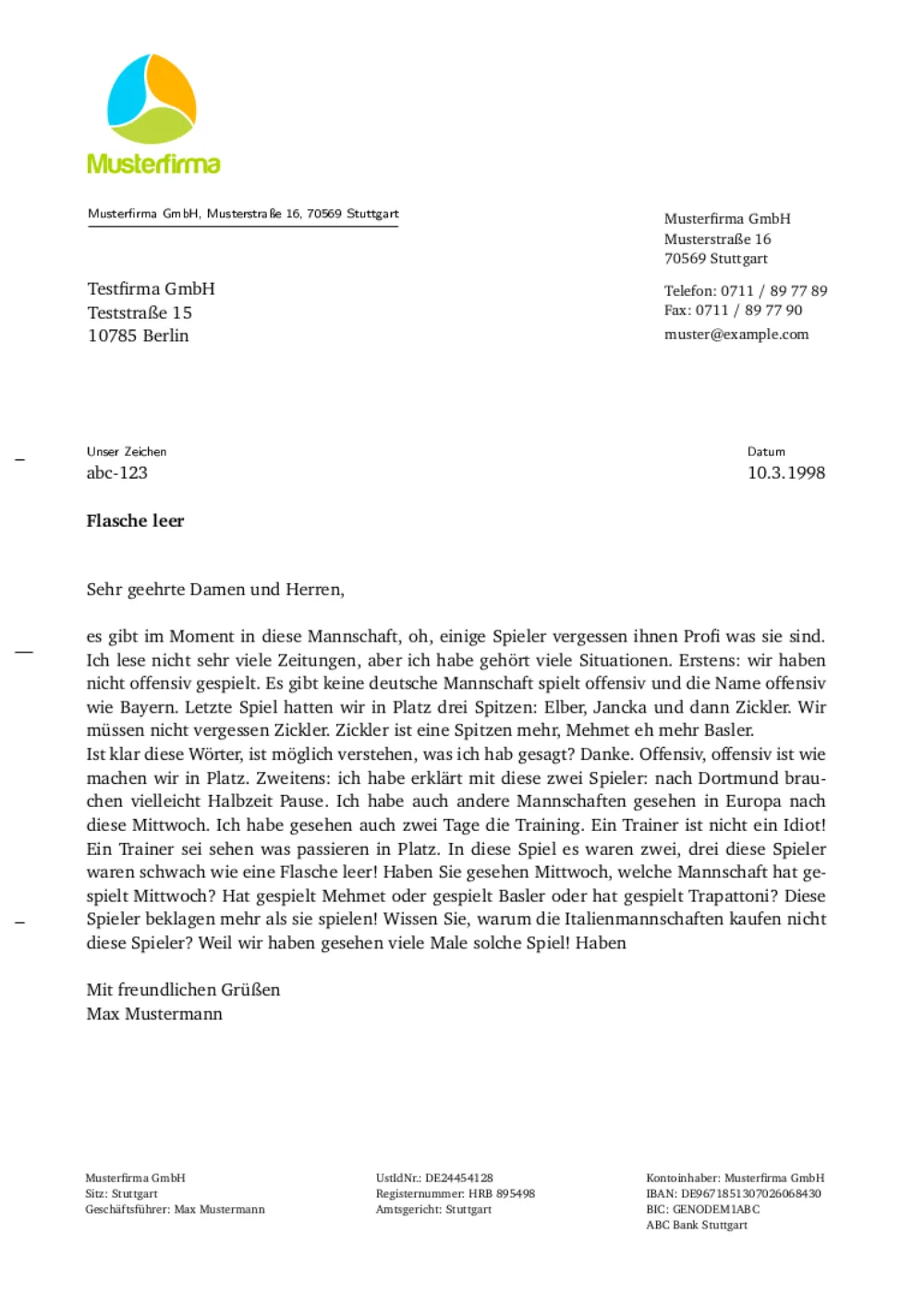
Internal communication documents — memos, telephone notes, departmental notices — are often overlooked when companies standardise their correspondence, yet they carry the same risk of ambiguity and lost information as any external letter.
The Role of Internal Documents in German Companies
In German business culture, written documentation of decisions, instructions, and communications is standard practice. Even matters that in other cultures would be handled informally — a verbal agreement, a telephone discussion, a decision made in a corridor — are frequently reduced to writing through a Memo, Telefonnotiz (telephone note), or brief internal letter. This is not bureaucratic excess; it is a practical response to the liability and record-keeping requirements that German businesses face.
Memos (Interner Vermerk)
The internal memo (Vermerk or Hausmitteilung) is used for short written communications between departments or between colleagues at different levels. It follows a simplified version of the DIN 5008 structure: sender name and department, recipient name and department, date, subject, and body text. It does not require a formal salutation or closing, but it should still use a consistent template to ensure that key information — particularly the date and the sender — is immediately identifiable.
Telephone Notes (Telefonnotiz)
A Telefonnotiz documents the content of a telephone conversation for the record. It is used when information, instructions, or agreements have been communicated by phone and need to be traceable. The standard template includes: date and time of the call, caller and recipient names, the purpose of the call, a brief summary of what was discussed, any agreements or actions arising, and the signature or initials of the person completing the note.
Telephone notes are particularly important in contexts where verbal agreements may later be disputed — supplier negotiations, customer complaints, HR discussions — because they create a contemporaneous written record that can be cited if clarification is needed later.
Meeting Records (Protokoll)
Meeting records (Besprechungsprotokoll) document the proceedings of formal meetings. They are more structured than memos and typically include: date, time, and location of the meeting, list of participants, agenda items, summary of discussion for each item, decisions made, action points with responsible persons and deadlines, and the signature of the recorder. Protocols have legal significance in some contexts — board meetings, works council meetings, and quality management processes in ISO-certified companies all require formally structured records.
Applying DIN 5008 Principles to Internal Documents
DIN 5008 is written specifically for external business correspondence, but its core principles — clear identification of sender and recipient, a subject line, a defined date field, consistent formatting — apply equally well to internal documents. Applying these principles to internal templates creates several practical benefits.
Clarity and Traceability
A memo without a date field or a telephone note without a clear sender name creates retrieval problems. When these documents are filed — physically or digitally — and need to be located months later, consistent formatting makes them searchable and interpretable by people who were not involved in the original communication.
Legal Record-Keeping
In German employment law, in particular, written records of instructions and decisions can be crucial in disputes. A standardised memo template ensures that legally relevant communications are always dated, attributed, and filed in a consistent location.
Digital vs. Paper Internal Communication
Most German companies have migrated a large proportion of internal communication to email and messaging platforms. This does not eliminate the need for structured document templates — many formal internal communications, performance reviews, disciplinary notes, and departmental policies are still produced as documents rather than emails, either for legal reasons or because they need to be signed. Templates remain relevant even in predominantly digital environments.
Maintaining Standards in Distributed Teams
As more German companies operate with remote or distributed teams, maintaining consistent document standards requires explicit policy rather than informal convention. Storing templates in a shared, centrally managed location, training new employees on their use, and periodically reviewing whether templates remain current are all practices that prevent the gradual drift into inconsistency.
Internal memo and telephone note templates, alongside the full range of external correspondence templates, are available at smartdexblog.de. For guidance on German record-keeping obligations in employment contexts, the Bundesministerium für Arbeit und Soziales provides relevant regulatory information.