A German invoice must satisfy two sets of rules simultaneously — the formatting guidelines of DIN 5008 and the mandatory content requirements of the Umsatzsteuergesetz (UStG), Germany's VAT law.
An invoice that fails on the legal side is not simply unprofessional — it can be rejected by the recipient's accounting department and may not be accepted as a valid document for VAT deduction purposes. An invoice that fails on the formatting side may still be legally valid but signals a lack of care that affects business relationships.
Mandatory Content Under UStG §14
Section 14 of the Umsatzsteuergesetz defines the minimum content requirements for a valid German invoice. Missing any of these fields can invalidate the invoice for VAT purposes, which means the recipient cannot use it as the basis for an input tax deduction (Vorsteuerabzug).
Required Fields
- Full name and address of the supplier — the issuing company's legal name and registered address.
- Full name and address of the recipient — the customer's legal name and registered address.
- Tax identification number or VAT ID — either the Steuernummer issued by the German tax authority (Finanzamt) or the Umsatzsteuer-Identifikationsnummer (USt-IdNr.).
- Invoice date — the date the invoice was issued, written in DD.MM.YYYY format.
- Sequential invoice number — a unique, consecutive number that cannot be reused. There is no required format, but it must be unique and traceable.
- Description of goods or services — a clear description of what was supplied, in sufficient detail for identification.
- Quantity and unit price — for itemised invoices, the quantity of each item and the net price per unit.
- Net total (Nettobetrag) — the total before VAT.
- Applicable VAT rate — currently 19% standard rate or 7% reduced rate in Germany, applied separately to each rate if multiple rates apply.
- VAT amount (Umsatzsteuerbetrag) — the actual amount of VAT being charged.
- Gross total (Bruttobetrag) — the total including VAT.
How DIN 5008 Formatting Helps
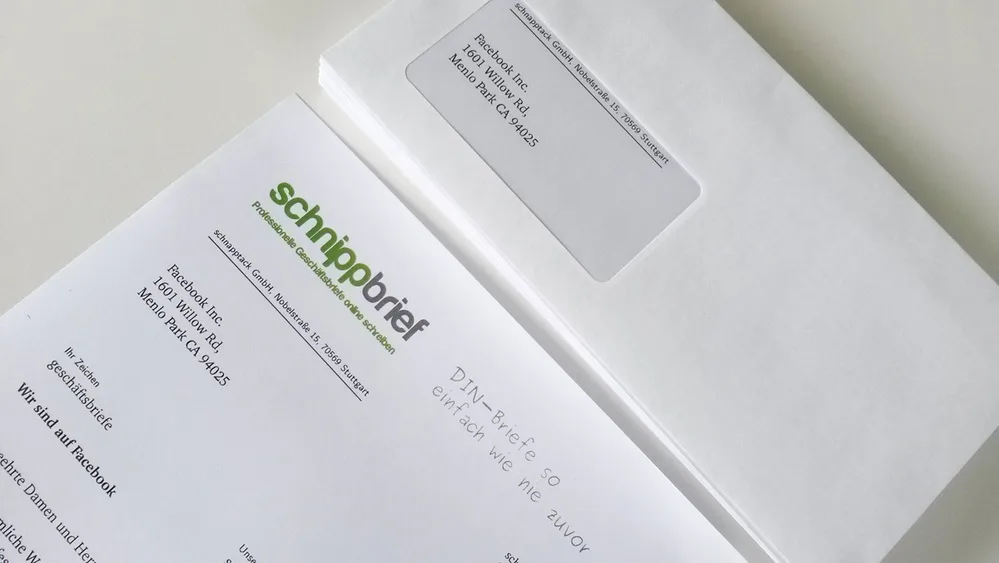
A DIN 5008-compliant invoice layout ensures that all the required UStG fields appear in a logical, expected order, making the document easy to verify and process. The standard's defined zones — letterhead at the top, address window in the correct position, a reference line for the invoice number and date, and a structured body for item descriptions and totals — map naturally onto the legal requirements.
Common Invoice Formatting Errors
Even when all the required content is present, poorly formatted invoices slow down payment processing. The most common problems include: placing the invoice number in a non-standard location where it is easily overlooked; using a table layout that does not clearly separate net, VAT, and gross amounts; omitting the VAT rate alongside the VAT amount; and using relative date references ("within 30 days") without also specifying an absolute payment due date.
Quick Checklist Before Sending
- Company name, address, and tax/VAT number present and correct.
- Recipient's full legal name and address.
- Unique sequential invoice number.
- Invoice date in DD.MM.YYYY format.
- Clear description of each item or service.
- Net amount per item and total net amount.
- VAT rate and VAT amount shown separately.
- Gross total clearly marked.
- Payment terms with absolute due date (e.g., "Zahlungsziel: 14.11.2026").
- Bank details (IBAN and BIC) if payment is by bank transfer.
The full text of UStG §14 is available through gesetze-im-internet.de, the German government's official legal text portal. For guidance directly from the tax authority, the Bundesfinanzministerium publishes regular updates on invoicing requirements. Pre-built invoice templates that meet both DIN 5008 and UStG §14 requirements are available at smartdexblog.de.