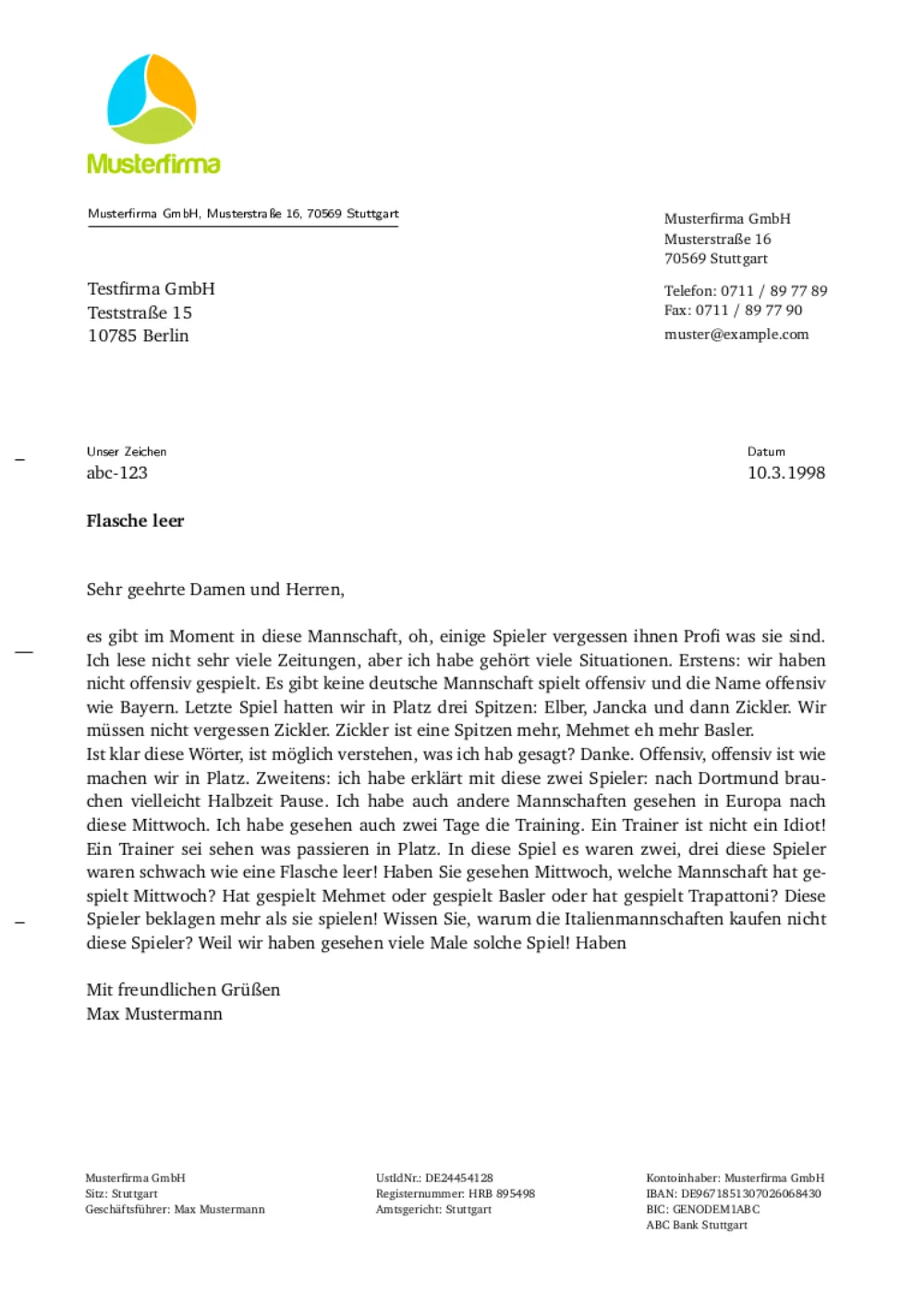
DIN 5008 is Germany's formatting standard for business correspondence, covering layout, spacing, and address fields. Companies across Germany use it to ensure consistent, professional letters that recipients can immediately navigate.
What DIN 5008 Actually Covers
The standard is published by the Deutsches Institut für Normung — the German Institute for Standardisation — and was most recently revised in April 2011. That update brought several existing norms under one roof and introduced guidelines for digital document creation, making it relevant for both printed letters and electronically shared files.
At its core, DIN 5008 is a set of recommendations rather than laws. No company faces a fine for sending a letter that does not conform to it. The value lies in clarity and professionalism: a DIN 5008-compliant letter signals that the sender knows the rules of German business communication, which carries real weight in a culture that values precision and reliability.
Layout and Spacing
The standard defines page margins (top: 27 mm, left: 24.1 mm, right: 81.9 mm for the type area in DIN A4 format), the position and size of the address window, the placement of fold marks on the left edge of the page, and the location of the hole-punch reference mark. These measurements exist so that a letter, once folded and inserted into a standard German window envelope, displays the address correctly without repositioning.
Address Fields and Reference Lines
DIN 5008 sets out the exact position and content of the address block — typically starting 50 mm from the top of the page — as well as the reference line (Bezugszeile) that carries identifiers such as Ihr Zeichen (your reference), Ihre Nachricht vom (your letter dated), Unser Zeichen (our reference), and the date. This structured header makes it straightforward for large organisations to process incoming and outgoing correspondence systematically.
Subject Lines, Salutations, and Closing
The standard provides guidance on how subject lines (Betreff) should be placed and formatted, what spacing to use between paragraphs, how to write salutations (Anrede) and closings (Grußformel), and how to indicate enclosures (Anlagen) and copies (Verteiler). Each element has a defined position relative to the others, so a reader familiar with DIN 5008 can scan any compliant letter and immediately locate the information they need.
The Three Related Norms: DIN 5008, DIN 676, and DIN 680
DIN 5008 does not stand alone. It works in conjunction with two companion standards that address the physical dimensions of the documents and envelopes used in German correspondence.
DIN 676 — Forms and Pre-printed Documents
DIN 676 governs the dimensions and layout zones of pre-printed business forms, including where address windows should appear on envelopes and how printed forms are divided into functional zones. When the 2011 revision of DIN 5008 was published, many of DIN 676's provisions for letter layout were integrated directly into the updated standard.
DIN 680 — Envelope Dimensions
DIN 680 specifies the sizes of standard German envelopes, ensuring that letters folded to the measurements defined in DIN 5008 fit correctly into the envelopes used throughout Germany. The most common format is the C4 envelope for unfolded A4 sheets and the DL envelope for letters folded into thirds.
Why DIN 5008 Matters for Businesses
Compliance with DIN 5008 signals professionalism. In Germany, first impressions are frequently formed by documentation quality — an invoice that looks hand-assembled, a letter with inconsistent font sizes, or an address block that does not align with the envelope window can all undermine credibility before the reader reaches the first sentence of the body text.
Corporate Identity Consistency
When an entire organisation uses the same DIN 5008-compliant letterhead, every outgoing document — from a simple internal memo to a contract sent to a key client — carries a unified visual identity. That consistency is a tangible component of corporate identity (CI), and it reduces the risk of different departments presenting the company in conflicting ways.
Legal and Administrative Clarity
Several categories of German business documents — invoices, formal notices, payment reminders, and employment-related correspondence — carry specific legal requirements that build on DIN 5008 formatting. Using a compliant template ensures that the required fields appear in the expected positions and that the document meets the basic presentation standards that German courts and authorities expect.
Practical Tips for Applying DIN 5008
The most efficient way to comply with the standard is to use a pre-built template that already incorporates the correct margins, address-field positions, and fold-mark indicators. Templates available at smartdexblog.de are structured to meet these requirements. When editing a template, the key is to preserve the positioning of structural elements — changing the font or the colour scheme is fine, but moving the address block or adjusting the margins will break compliance.
For organisations that handle large volumes of correspondence, integrating DIN 5008-compliant templates into their document management system ensures that all users start from the same baseline. This is far more reliable than distributing a template file and hoping each employee uses it correctly.
Further technical detail on the standard itself can be found at the official DIN website, where the full text of DIN 5008 is available for purchase.
Whether you are setting up correspondence templates for a new business or reviewing the documents your company already uses, understanding DIN 5008 is the first step toward professional, consistent, and legally sound business letters in Germany.